
Travalet
A travel app where your trips live on your devices, not on someone else's server
Spec sheet
- Status
- On the App Store
- Kind
- App
- Started
- 2025
- Role
- Solo build, Take Off Go
- Platforms
- iOS, iPadOS, macOS
- Stack
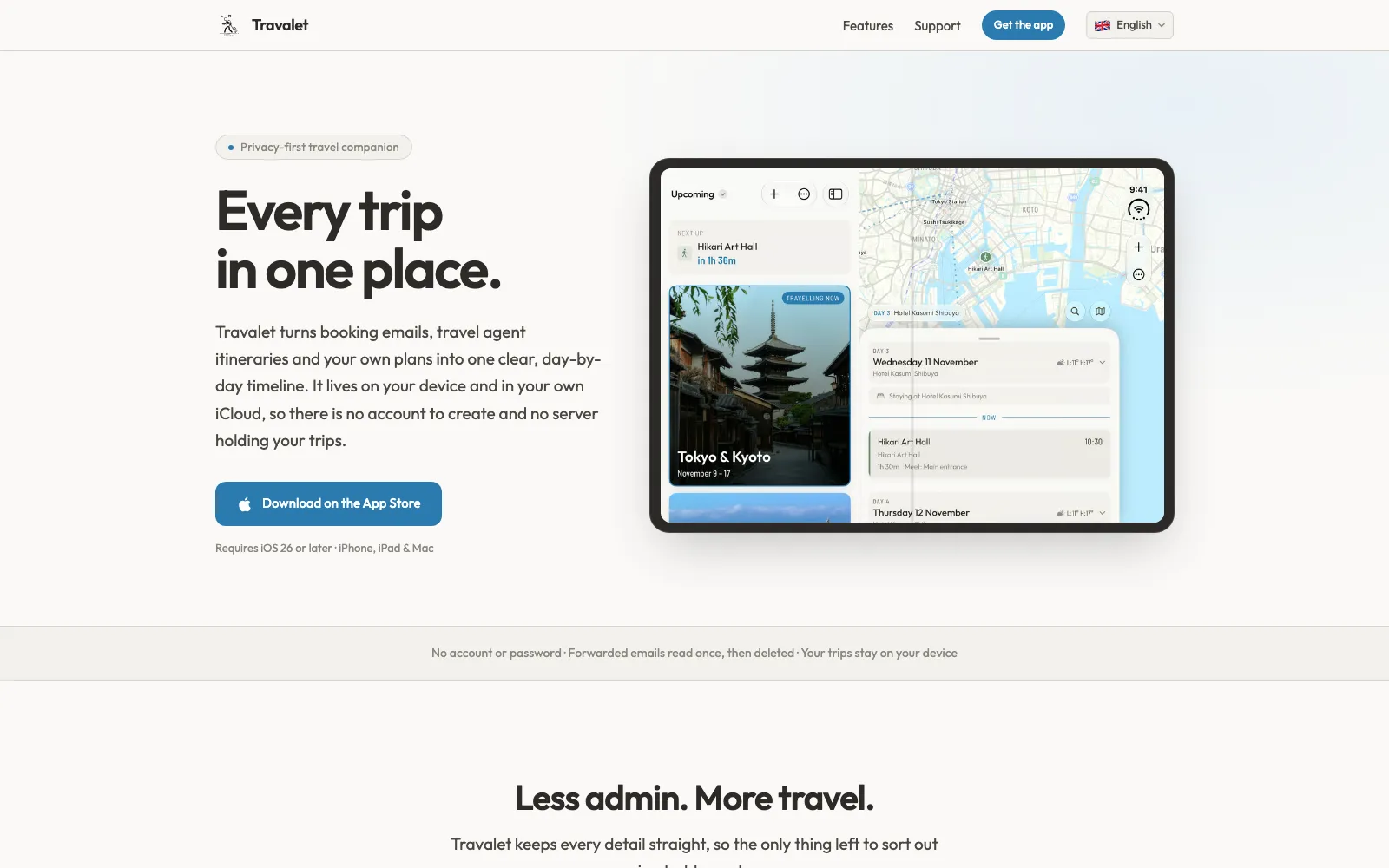
Your trips, your devices#
Most travel apps want an account and your itinerary on their servers. I started building the opposite in 2025: a travel companion where the trips belong to the traveller, live on their own devices and sync through their own iCloud.
Travalet is that app, native on iPhone, iPad and Mac, and on the App Store. There's no Travalet account. There's no Travalet server holding anyone's itinerary. I built it on my own, alongside a day job.
Forward the email, get the trip#
Forward the confirmation for a flight, hotel, hire car, train, ferry, tour or restaurant and it's read once, turned into structured trip items and pushed to your phone, and then the email is deleted.
Reading free-form booking emails with a language model is easy to demo and hard to trust. The parser is measured against a suite of real-shaped cases with scored baselines, so a change that makes it worse shows up before it ships.
Travel agents can also send a curated itinerary straight to a client's phone, arriving with the agency's branding, images, maps and recommendations alongside the traveller's own bookings.
Sharing, with nobody in the middle#
The hardest engineering in the app is sharing a trip with the people you travel with when there's no server to share it through. SwiftData can sync to CloudKit on its own, but that path doesn't support shared zones, so I don't use it. SwiftData is a local store, and every CloudKit read and write goes through a mirroring layer I wrote and own, with its own change tokens, delta fetches and conflict handling. It's the piece of this app I'm proudest of, and the one it would have been easiest to talk myself out of.
Each booking is a small independent item. Items live in pools, which are the unit of sharing and map to shared iCloud zones. A trip is a view over the items whose dates overlap rather than a box they sit in. Companions join with their Apple ID, get view-only or edit access, and lose it when you revoke it.
The compiler as a second reviewer#
Owning a sync engine means owning its bugs, so the compiler catches what it can. The domain model and the persistence layer are separate Swift packages, the project builds under Swift 6 strict concurrency, and the sync mirrors run on actors so isolation is checked rather than assumed.
It ships widgets and a share extension in English, Spanish and Simplified Chinese, and the Mac app is native, not a port.