
Cavok
The pilot logbook I wanted, built to CASA's rules and shipped to the App Store
Spec sheet
- Status
- On the App Store
- Kind
- App
- Started
- 2026
- Role
- Solo build, Take Off Go
- Platforms
- iOS, iPadOS, Web
- Stack
From spreadsheet to App Store#
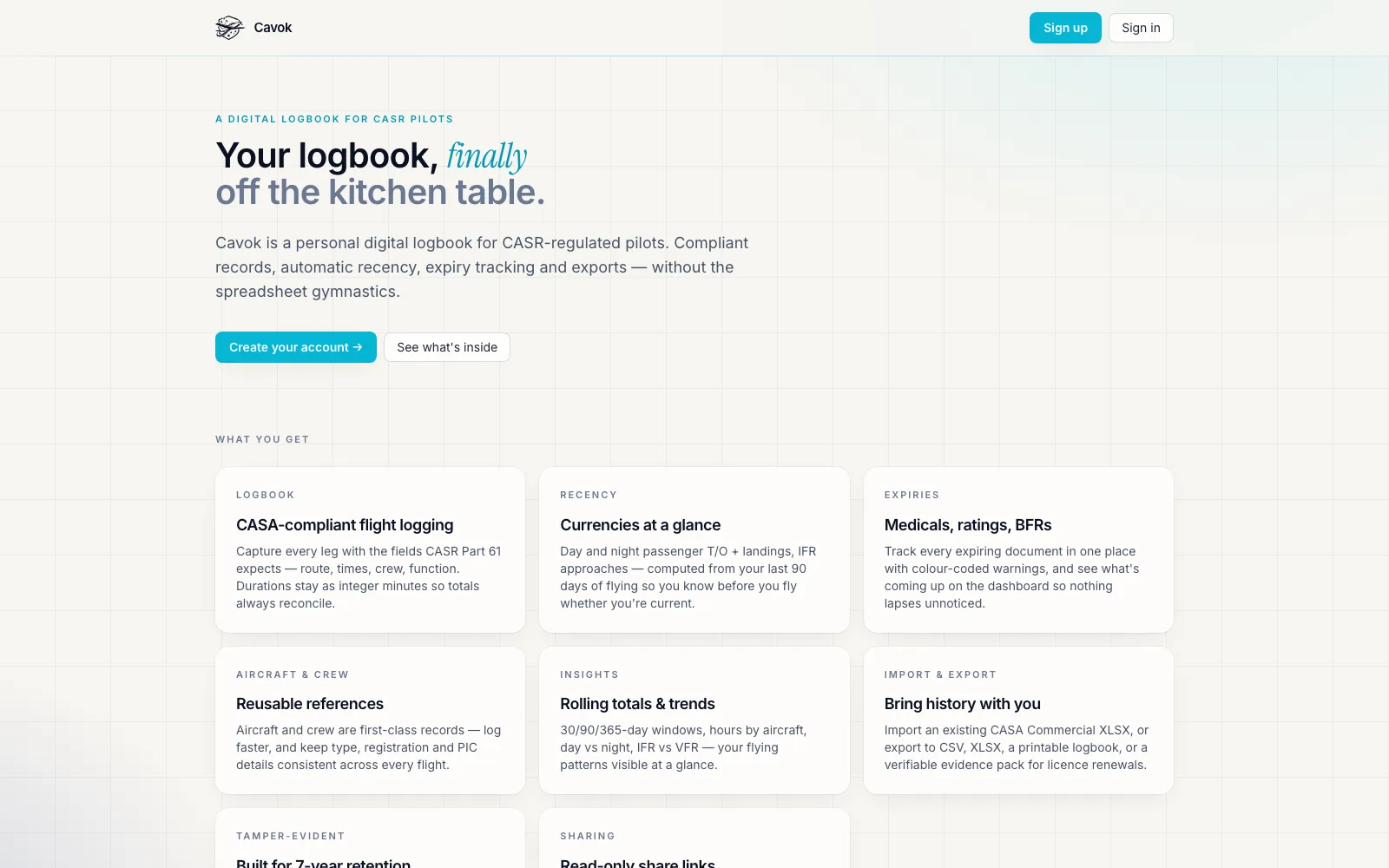
I fly, and my logbook used to be a spreadsheet built on the CASA template. It was fine until I needed the things a spreadsheet is bad at: knowing whether I was current to carry passengers at night, or producing clean pages for a licence renewal.
Cavok is what replaced it. It's a logbook for any pilot flying under CASR Part 61, on the web at cavok.au and as a native iPhone and iPad app that works with no signal and syncs when you land. I designed and built all of it myself: first commit in May 2026, version 1.0 on the App Store that November. Seeing that approval come through was a good day.
The first milestone was importing my own logbook and reconciling every total against the original, to the minute.
The regulation is the spec#
I started from CASR 61.345 and 61.355: what a logbook has to record, and that it must be kept for seven years with entries unaltered. Every write to a flight goes through one function that appends to a history table. Deletes are soft. An edit never overwrites the original. Durations are whole minutes, because decimal hours drift once you add up a few thousand flights.
Cavok works out 90-day day, night and instrument recency, counts down the days left on medicals, flight reviews and ratings, prints CASA-style pages with brought-forward and carried-forward totals, and exports CSV, XLSX or an evidence pack. Instead of a stack of photocopies, a pilot sends an instructor or examiner a read-only link.
Two languages, one right answer#
The web app runs on Cloudflare Workers with D1. The iPhone app keeps its own SQLite database so it works where there's no reception. Two codebases holding the same records is how a product starts disagreeing with itself. I closed both gaps by design.
Schemas: the same SQL migration files are applied verbatim to D1 and to the on-device database. They agree by construction, not by care.
Maths: recency, expiries and totals exist in TypeScript and in Swift, and both test suites read the same JSON vectors of inputs and expected outputs. Either suite fails if a vector exists with no test wired to it. A change to the arithmetic lands in both languages and the vectors together, or it doesn't land. Where the two languages genuinely differ, such as dates before the 1582 calendar change, it's written down at the call site.
Signing in#
Sign-in is a code sent to your email, with no password to manage, and you can delete your account and its data from Settings at any time.