One product, four doors
DX, UX and EX now have company. Agents are a fourth way into every product, and building for them changes what the product is: one core with four doors.
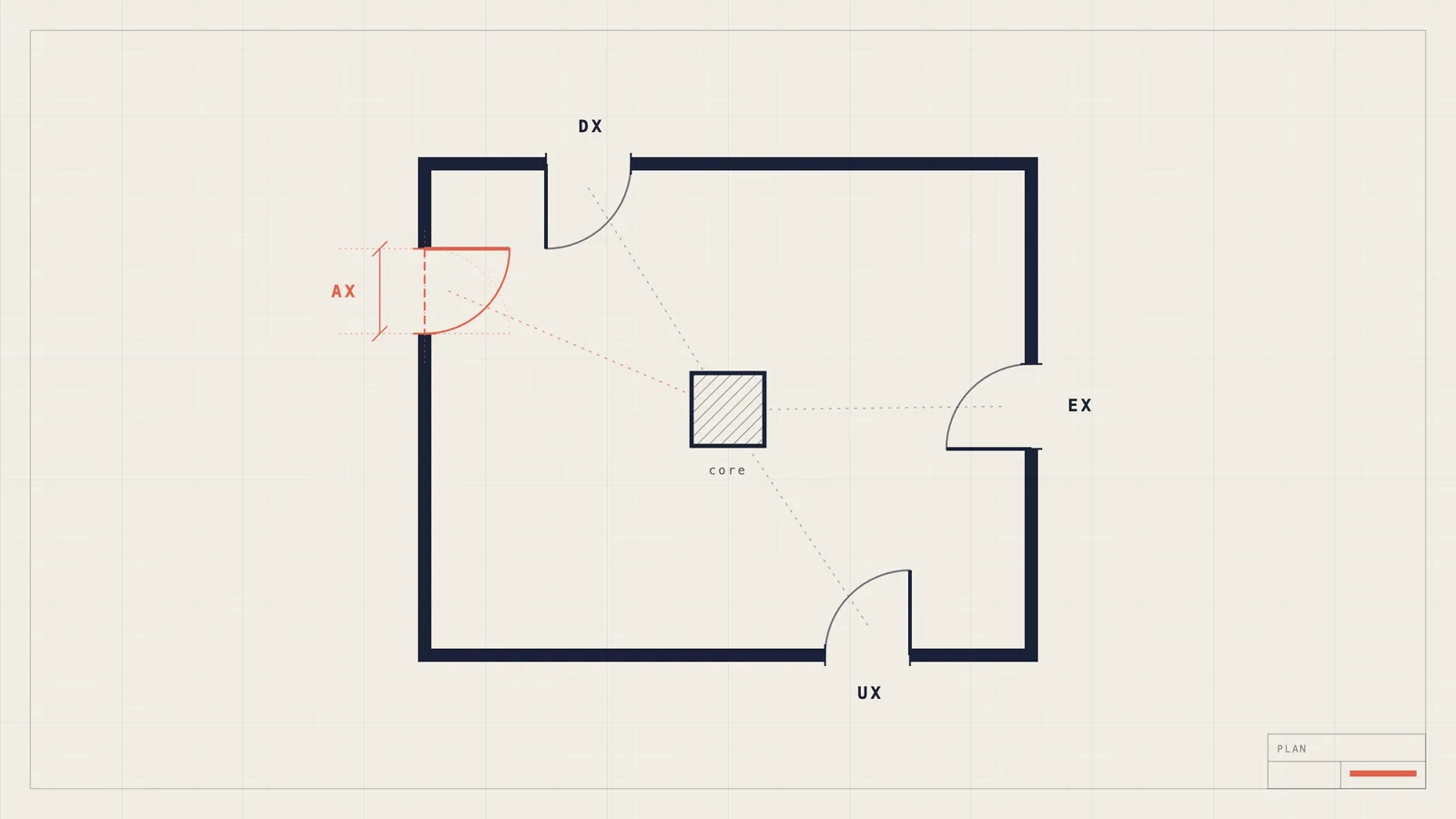
We've had DX for years. Developer experience is how it feels to build on something: the docs, the errors, the time from clone to first green test. Alongside it sit two older ideas. UX is the experience of the people the product is for. EX, the editor experience, is the experience of the people who run it: the admins, content editors and operators who live in the back office.
There's now a fourth, and it isn't a niche. AX is the agent experience, meaning what it's like for an AI agent to use your product. Agents already write much of our code, and more and more they also operate the software that code produces, on behalf of someone who would otherwise be clicking through it.
For most of this year I treated AX as a feature to add. A couple of projects have changed my mind. AX isn't a fourth audience bolted onto the side. It changes what the product is.
The pane I stopped opening#
Jambo is the operations platform behind a travel business. It builds quotes and itineraries: properties, rooms, transfers, prices and the copy that goes to the customer. We rebuilt it this year, and on the first day of the rebuild we gave it an assistant: a chat pane in the trip editor where you could type "move the second lodge to three nights" and watch it happen.
It was good work. The pane didn't edit the screen directly. It compiled sentences into the same typed operations the editor's own buttons produce, so the editor, the assistant and the importer all spoke one vocabulary. Every turn could be undone in one step. Anything that changed a price waited for a person to press confirm.
Then I stopped opening it.
Nothing broke. The trouble was that real work never stays inside one app. A quote starts as a supplier's PDF attached to an email, picks up a detail from a conversation and a fact sheet on someone's drive, and ends with copy that has to sound like the business. The pane could only see Jambo. Claude, running on my machine, could already see everything else, so the obvious move was to let it see Jambo too.
So on day 24 we shipped an MCP server, which let any MCP client use Jambo's tools under the same sign-in as the staff app. The decision record is blunt about why. Claude Desktop, Claude Code and the others are each "a better place to read a supplier PDF, paste a fact sheet or ask a question across the whole business than a chat pane inside Jambo, and each already holds a model that can call tools."
The embarrassing part is that we should have known. The system Jambo replaced already ran on MCP, and quotes were adjusted through MCP tools with Claude writing the copy. We still built a chat pane first, because that's what an AI feature is supposed to look like.
The pane is still there. It wasn't wasted, either, and that's the interesting part.
One core, four doors#
The same day the MCP server shipped, we moved the tool registry out of the assistant's folder and into a shared one, "so neither caller owns it", in the decision record's words. Every tool the assistant had, around thirty of them at that point, was exposed to outside agents without being rewritten, because the pane had already forced us to build them as clean, typed operations rather than UI handlers.
That move is the whole idea. The product isn't its screens. It's a core of operations, the rules about who can run which of them, and a record of who did. The screens are one way in. A CLI or an API is another. An agent is a third. Each is a door into the same room.
| Door | Who comes through it | What they need from it |
|---|---|---|
| DX | developers, and the coding agents working beside them | a codebase whose rules are enforced, not just written down |
| EX | editors, admins and operators | visibility, review and an undo |
| UX | the people the product is for | something fast and clear that never surprises them |
| AX | agents acting for any of the above | typed tools, honest errors and permissions that hold |
When AX is treated as a feature, the agent gets its own back door: a bespoke endpoint, a service account with broad rights, and logic that drifts from what the screens do. When it's treated as a door, the agent inherits everything the core already enforces.
In Jambo that inheritance is concrete. Every change records an actor, and changes made over MCP also record which client they came through, so the audit log shows whether a person clicked it in the editor or Claude Desktop did it on their behalf. The list of operations an agent may not perform is data in the core, so a new caller picks it up automatically. Copy about a property is requested rather than written. An agent supplies the source material, and Jambo's own pipeline writes the copy, so a model can't fill the gaps with what it vaguely remembers about the lodge.
Each door changes the others#
The useful surprise is that the doors don't just coexist. Designing for one makes the others better.
AX made our DX honest. The process we ship with exists because agents write so much of our code. Rules an agent might skip became checks it can't, and those checks protect the people on the team just as well.
EX turned out to be AX's interface. This site runs on Folio, our open-source CMS. Its schema lets each field carry help text, guidance and length limits for the editor, and the site carries a writing guide. The MCP server hands an agent that same schema, and a check tool reports anything that doesn't fit. The words we wrote for a person filling in a form are exactly what an agent needs to fill it in well. If your admin screens explain themselves, you've already written most of your agent documentation.
AX needs EX to stay safe. Jambo's MCP server deliberately has no confirm tool. A model's next tool call looks exactly like a person's click, so an agent that could propose a price change and then confirm it would be confirming itself. Over MCP, a price-affecting change on an accepted trip becomes a stored proposal, and a person applies it in Jambo. The agent door works because there's an editor door to send it to.
UX moves into the user's own agent. This is where it gets interesting.
Bring your own trainer#
Notchel is a workout tracker I've been building for my own iPhone. It's on TestFlight and I use it every day. The plan for its next stage is the purest version of this idea I've found.
I don't want to build a coaching AI into it. I'd have to pay for the model, choose it, prompt it, keep it current and persuade people to trust a stranger's chatbot with their training. People already pay for an assistant they know, which knows them, and which is improving faster than anything I could build.
So the plan is that you use your own agent as your trainer. It reads your recent training, writes a program in a format the app understands, and the program arrives in Notchel as a draft. Nothing changes until you accept it.
Designing that has been mostly an exercise in AX, and it has meant thinking about failure in a different way:
- Report every problem at once. A person fixes one error and tries again. An agent does better with the whole list in one response, each item with its path, the reason and a suggested fix, including the closest matching exercises when it uses a name the app doesn't know.
- Don't ask a model to invent identifiers. The program format has no ids for the agent to mint. The app assigns them on import.
- Generate the instructions from the contract. The brief that tells an agent how to write a program is built from the same schema the app validates against, so the two can't drift apart.
- Keep the agent out of the dangerous fields. A program prescribes sets, reps and effort, never kilograms. The weight stays with the person standing at the bar.
There's also a route that needs no integration at all: publish the brief, have any assistant write a file, and open it in the app. A good agent door doesn't require a particular agent.
None of this is built yet. It's designed, written up and parked until next year while the tracker itself settles. But it has already changed how I think about the app. Notchel's UX is no longer only the screens I design. Part of it is now a conversation in someone else's app, with a model I don't control, and my job is to make that conversation go well.
Agents propose, people commit#
Jambo and Notchel arrived independently at the same rule, and I now think it's the rule for the agent door in general. An agent can read, search, draft and propose as much as it likes. Anything that is hard to undo, or that a person will be held accountable for, waits for a person.
That isn't a limit on agents. It's what lets you open the door wide. If the worst a confused or manipulated agent can do is leave a draft that someone has to review, you can give it a lot of tools.
If you're building something now, here's what I'd do:
- Put the operations in a core that no single caller owns. Screens, scripts and agents should all call the same typed operations.
- Record the actor and the door on every change. "Who did this?" is now a question with a real answer only if you log it.
- Make permissions data, not convention. Then a new door inherits them.
- Write field help as if it will be read by a machine. It will be.
- Never give an agent a tool that confirms its own proposal. Send it to the editor door instead.
- Treat the user's own agent as a client you design for, the same way you'd design for a browser you don't control.
How this post got here#
This post went through all four doors.
I asked Claude for it in a terminal, with my repositories at hand. That's the DX door, and it's also where the Jambo and Notchel details were checked against their git history rather than my memory. That check is how I was reminded that the Jambo pane was never removed, and that its MCP server arrived only 24 days in.
Claude then wrote the draft into this site through Folio's MCP server. Every edit landed in the same log as an editor's keystrokes, attributed to its token and undoable. That's the agent door. Publishing is a separate step, and it was left to me.
I read the draft in Folio's editor, changed what didn't sound like me, and pressed publish. That's the editor door. You're reading it through the last one.